
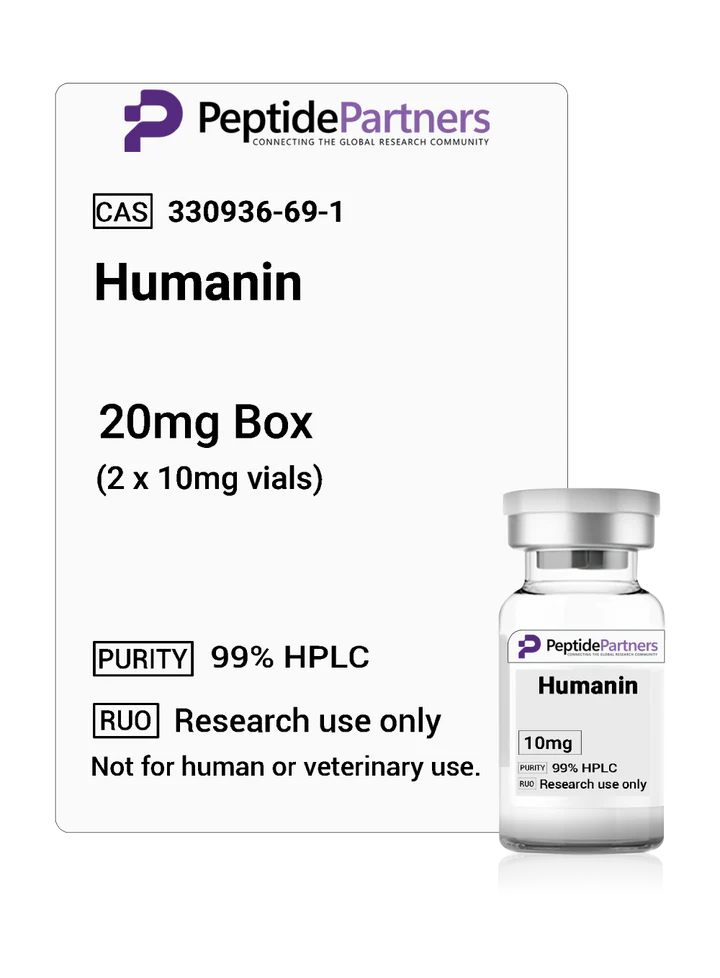
Humanin (10mg vials)
Price range: $165.00 through $720.00
• Purity: 99.92% (multi-vial, independently tested)
• Format: 10mg vials (3 mL capacity)
• Box Options: 20mg, 50mg, 100mg combinations
• Testing Status: Endotoxin & purity screening PASSED
• Cost Efficiency: $7.20 – $8.25 per milligram
Humanin is a mitochondria-derived peptide compound used in preclinical research to study cellular stress responses, mitochondrial bioenergetics, and peptide aggregation mechanisms. This research-grade material supports in-vitro experimentation focused on neurodegenerative pathways, oxidative stress models, and integrin-mediated signaling studies.
- Independent certificate details, manufacturer IDs, and batch IDs should be reviewed before purchase when available.
- Order cancellations for full refunds are available before shipment; shipped orders cannot be cancelled or refunded.
- For damaged or incorrect goods, photograph the outer packaging, inner packaging, and product labels, then email support within 48 hours of carrier delivery.
Buy Humanin – Peptide Partners
Product Overview & Specifications
Humanin is a mitochondria-derived peptide compound investigated for its role in cellular stress responses, mitochondrial bioenergetics, and peptide aggregation mechanisms. Peptide Partners supplies this research-grade material for in-vitro testing, laboratory experimentation, receptor pharmacology, structural biology, and preclinical metabolic research.
Published studies have examined Humanin using transmission electron microscopy, biophysical fibrillization assays, oxidative stress models, primary retinal pigment epithelial cells, glioblastoma cell lines, and preclinical tumor models. Research areas include integrin-mediated signaling, TGFβ pathway activation, amyloid-like fibril formation, BCL-2 family interactions, mitochondrial DNA regulation, and age-related degeneration pathways.
The product name supplied for this listing is “Humanin.” Researchers should verify the exact identity, sequence, formulation, and batch-specific certificate of analysis before beginning any experiment. Findings from published Humanin studies should not be assumed to apply to every commercial batch or formulation.
Product Specifications
| Specification | Details |
|---|---|
| Product name | Humanin |
| Compound type | Mitochondria-derived peptide (24 amino acids) |
| Primary molecular targets | Integrin αVβ8, BCL-2 family proteins, mitochondrial compartments |
| Primary research areas | Cellular stress responses, mitochondrial bioenergetics, peptide aggregation, glioblastoma signaling, retinal degeneration, and oxidative stress models |
| Product format | 10 mg vials |
| Vial size | 10 mg |
| Vial capacity | 3 mL |
| Available box combinations | 20 mg, 50 mg, and 100 mg |
| Multi-vial purity | 99.92% |
| Independent testing | Yes |
| Endotoxin screening | Passed |
| Purity screening | Passed |
| Manufacturer ID | WF03 |
| Batch ID | HP20250805 |
| Cost per milligram | $7.20–$8.25 |
The stated 99.92% purity is based on multi-vial testing. Researchers should review the batch-specific certificate of analysis before beginning any experiment.
Primary Research Studies & Findings
Humanin Activates Integrin αV–TGFβ Axis and Leads to Glioblastoma Progression
Authors: Cuong P. Ha, Tuyen N. M. Hua, Vu. T. A. Vo, Jiyeon Om, Sangwon Han, Seung-Kuy Cha, Kyu-Sang Park, and Yangsik Jeong
Publication: Cell Death & Disease (Nature), 2024
DOI: 10.1038/s41419-024-06790-8
Reference: View publication
This study investigated the role of Humanin in glioblastoma progression using in silico, in vitro, and in vivo approaches. The researchers demonstrated that Humanin is highly expressed in glioblastoma tissues and binds directly to integrin αVβ8 receptors on glioblastoma stem cells.
Humanin was reported to induce glioblastoma stem cell attachment, filopodia formation, and migration through activation of the integrin αV–TGFβ signaling axis. This led to canonical TGFβ pathway activation, promoting tumor cell invasion, angiogenesis, and overall tumor aggressiveness in the tested models.
The study combined computational modeling, cell-based assays, and animal models to show that Humanin facilitates glioblastoma progression via integrin-mediated cell adhesion and subsequent TGFβ signaling. The researchers suggested that targeting the Humanin–integrin–TGFβ axis may offer therapeutic potential for glioblastoma treatment strategies.
Plain-English Research Summary
This study shows that Humanin helps brain cancer cells stick together and move more aggressively by binding to specific cell receptors and turning on growth signals. The findings suggest that blocking this pathway could offer new treatment approaches for this deadly cancer. The results are from laboratory and animal models and do not establish human treatment effects.
Humanin Variants Aggregate to Produce Different Fibril Morphologies
Authors: Daniel L. Morris, Sarah B. Nyenhuis, James M. Gruschus, David A. Nyenhuis, Rashmi Puja, Jenny E. Hinshaw, and Nico Tjandra
Publication: Journal of Biological Chemistry (ScienceDirect), 2025
DOI: 10.1016/j.jbc.2025.102253
Reference: View publication
This study investigated the fibrillization of Humanin and its variants using transmission electron microscopy and other biophysical techniques. The researchers demonstrated that Humanin forms amyloid-like β-sheet fibrils and that specific mutations can inhibit this fibrillization process.
These mutations were linked to secretion deficiencies in vitro, emphasizing the role of β-sheet structures in membrane interactions. The study highlighted that structural transitions are necessary for Humanin to interact with BCL-2 family proteins and inhibit apoptosis, suggesting that fibrillization is a key aspect of Humanin’s cytoprotective function.
The findings provide mechanistic insights into how Humanin’s conformation affects its interaction with cell membranes and survival proteins. The research supports the hypothesis that peptide aggregation behavior is essential for biological activity in laboratory systems.
Plain-English Research Summary
This research explores how Humanin clumps together to form fiber-like structures, similar to those seen in some diseases. The scientists found that the protein’s ability to form these fibers is crucial for its protective effects against cell death. The results are from cell experiments and do not establish human health effects.
The Mitochondrial-Derived Peptide Humanin Protects RPE Cells From Oxidative Stress, Senescence, and Mitochondrial Dysfunction
Authors: Parameswaran G. Sreekumar, Keijiro Ishikawa, Chris Spee, Hemal H. Mehta, Junxiang Wan, Kelvin Yen, Pinchas Cohen, Ram Kannan, and David R. Hinton
Publication: Investigative Ophthalmology & Visual Science, 2016
PMCID: PMC4811181
Reference: View publication
This study investigated the expression of Humanin in human retinal pigment epithelial (hRPE) cells and its effects on oxidative stress–induced cell death, mitochondrial bioenergetics, and senescence. Humanin was found to localize to cytoplasmic and mitochondrial compartments in RPE cells.
Exogenous Humanin was taken up by RPE cells, colocalizing with mitochondria, and inhibited reactive oxygen species formation while restoring mitochondrial bioenergetics. Humanin increased mitochondrial DNA copy number, upregulated the mitochondrial biogenesis regulator mtTFA, and protected RPE cells from oxidative stress–induced apoptosis and senescence.
The peptide also maintained transepithelial resistance in polarized RPE monolayers under oxidative stress. The data suggest Humanin could be a potential research tool for studying retinal degeneration, including age-related macular degeneration (AMD), in laboratory settings.
Plain-English Research Summary
This study shows that Humanin helps protect vision-critical eye cells from damage caused by oxidative stress. When extra Humanin is added, it gets into the cells and helps keep their mitochondria healthy, prevents cell death and aging, and helps maintain the cellular barrier. The findings suggest Humanin might be useful in developing research models for age-related eye diseases like macular degeneration.
Standard Research Disclaimer
Research Use Only. Not for use in diagnostic tests.
This product is solely intended for research purposes as a chemical compound. It is designated exclusively for in-vitro testing and laboratory experimentation. All information provided about this product is educational and should be evaluated by appropriately qualified research personnel.
By law, bodily introduction of this product into humans or animals is strictly prohibited. This compound must not be used, administered, or represented as a drug, food, dietary supplement, weight-management product, lipid-lowering product, cancer treatment, diagnostic material, or medical treatment. It is not intended to diagnose, treat, cure, or prevent any disease. It should be handled only by licensed and qualified professionals in an appropriately equipped laboratory and in accordance with applicable laws, institutional procedures, and relevant safety requirements.
| Choose pack |
2 vials × 10mg (20mg total) ,5 vials × 10mg (50mg total) ,10 vials × 10mg (100mg total) |
|---|
- All of our manufacturing partners produce peptides using the Lyophilization (Freeze Drying) process, ensuring products maintain stability for shipping and storage for 12+ months.
- In lyophilized form, they are shelf-stable for many weeks. However, for long-term storage, it is recommended to store them in the freezer.
- We often hear concerns about the standard "discard after 28 days of first use" disclaimer. Don't worry, this has nothing to do with studies regarding the efficacy of specific peptides. 28 days is the FDA requirement for producers of multi-use vials to prove their bacteriostatic maintains efficacy. This minimum requirement becomes the de facto standard.
- In our experience, if you use proper sterile procedures and refrigerated storage, you can continue sampling from the same reconstituted vial for 3+ months.
Certificate records
No published certificate records are available for this product.
Search Certificate LedgerRelated products
CJC-1295 no DAC (10mg vials)
Price range: $117.00 through $888.00
DSIP (5mg vials)
Price range: $75.00 through $305.00
